(eb04ab9117336f2b3613244cfe8a528c52faf6d6)
A regular expression parser. More...
#include "prism/defines.h"#include "prism/parser.h"#include "prism/encoding.h"#include "prism/util/pm_memchr.h"#include "prism/util/pm_string.h"#include <stdbool.h>#include <stddef.h>#include <string.h>
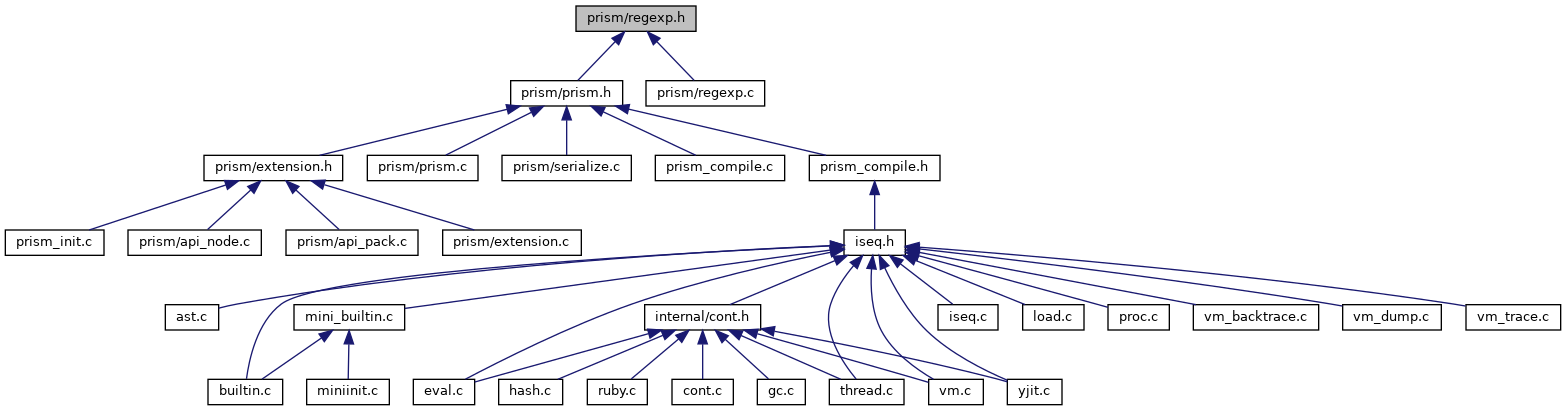
Go to the source code of this file.
Data Structures | |
| struct | pm_regexp_name_data_t |
| Accumulation state for named capture groups found during regexp parsing. More... | |
Typedefs | |
| typedef void(* | pm_regexp_name_callback_t) (pm_parser_t *parser, const pm_string_t *name, bool shared, pm_regexp_name_data_t *data) |
| Callback invoked by pm_regexp_parse() for each named capture group found. | |
Functions | |
| PRISM_EXPORTED_FUNCTION pm_node_flags_t | pm_regexp_parse (pm_parser_t *parser, pm_regular_expression_node_t *node, pm_regexp_name_callback_t name_callback, pm_regexp_name_data_t *name_data) |
| Parse a regular expression, validate its encoding, and optionally extract named capture groups. | |
| void | pm_regexp_parse_named_captures (pm_parser_t *parser, const uint8_t *source, size_t size, bool shared, bool extended_mode, pm_regexp_name_callback_t name_callback, pm_regexp_name_data_t *name_data) |
| Parse an interpolated regular expression for named capture groups only. | |
Detailed Description
A regular expression parser.
Definition in file regexp.h.
Typedef Documentation
◆ pm_regexp_name_callback_t
| typedef void(* pm_regexp_name_callback_t) (pm_parser_t *parser, const pm_string_t *name, bool shared, pm_regexp_name_data_t *data) |
Callback invoked by pm_regexp_parse() for each named capture group found.
- Parameters
-
parser The main parser. name The name of the capture group. shared Whether the source content is shared (impacts constant storage). data The accumulation state for named captures.
Function Documentation
◆ pm_regexp_parse()
| PRISM_EXPORTED_FUNCTION pm_node_flags_t pm_regexp_parse | ( | pm_parser_t * | parser, |
| pm_regular_expression_node_t * | node, | ||
| pm_regexp_name_callback_t | name_callback, | ||
| pm_regexp_name_data_t * | name_data | ||
| ) |
Parse a regular expression, validate its encoding, and optionally extract named capture groups.
Returns the encoding flags to set on the node.
- Parameters
-
parser The parser that is currently being used. node The regular expression node to parse and validate. name_callback The optional callback to call when a named capture group is found. name_data The optional accumulation state for named captures.
- Returns
- The encoding flags to set on the node (e.g., FORCED_UTF8_ENCODING).
Encoding validation walks the raw source (content_loc) to distinguish escape-produced bytes from literal bytes. Named capture extraction walks the unescaped content since escape sequences in group names (e.g., line continuations) have already been processed by the lexer.
◆ pm_regexp_parse_named_captures()
| void pm_regexp_parse_named_captures | ( | pm_parser_t * | parser, |
| const uint8_t * | source, | ||
| size_t | size, | ||
| bool | shared, | ||
| bool | extended_mode, | ||
| pm_regexp_name_callback_t | name_callback, | ||
| pm_regexp_name_data_t * | name_data | ||
| ) |
Parse an interpolated regular expression for named capture groups only.
No encoding validation is performed.
- Parameters
-
parser The parser that is currently being used. source The source content to parse. size The length of the source content. shared Whether the source points into the parser's source buffer. extended_mode Whether or not the regular expression is in extended mode. name_callback The callback to call when a named capture group is found. name_data The accumulation state for named captures.
This is used for the =~ operator with interpolated regexps where we don't have a pm_regular_expression_node_t. No encoding validation is performed.
Note: The encoding-tracking fields (has_unicode_escape, has_hex_escape, etc.) are initialized but not used for the result. They exist because the parsing functions (pm_regexp_parse_backslash_escape, etc.) unconditionally update them as they walk through the content.